
Discover What StoryDirector Makes Possible
See what deterministic cinematic compilation produces. Seventeen intelligence systems move from narrative truth to shot direction, automatic cast identity, continuity, and pre-spend governance.
Explore how structured story compilation translates narrative intent into production-grade shot specifications, camera grammar, and escalation curves.
Creative Translation
For Human Storytelling
The engine compiles your story into structured shot specifications — deterministic, version-pinned, production-ready.
Inside the StoryDirector Workflow
See how each layer of the Intelligence Engine transforms story into cinematic direction.

StoryCore™ — Narrative Intelligence
StoryCore™ freezes the approved narrative truth. BeatMap™ finds the story's turns and carries each source-linked beat into ScriptIR. Together they preserve what the story means before any shot is directed.
What you're seeing: Written intent becoming source-linked structure the compiler can trace.



SRC™ — Scene Reality Compiler
SRC takes each linked story beat and authors the filmable action and physical consequence that carry it into the shot plan. Validation belongs to the audit gates; SRC creates scene reality.
What you're seeing: Narrative beats becoming deterministic, source-linked action inside ScriptIR.

DirectorLogic™ — Cinematic Reasoning
DirectorLogic™ orchestrates the v6.5 compilation era: SRC for authored action, VAOE™ for blocking, MOMA™ for escalation, LO™ for camera grammar, ID™ for physics, and KI™ for motion calibration.
What you're seeing: Complete shot specifications with camera grammar, physics consequences, and escalation positions — compiled from your story.
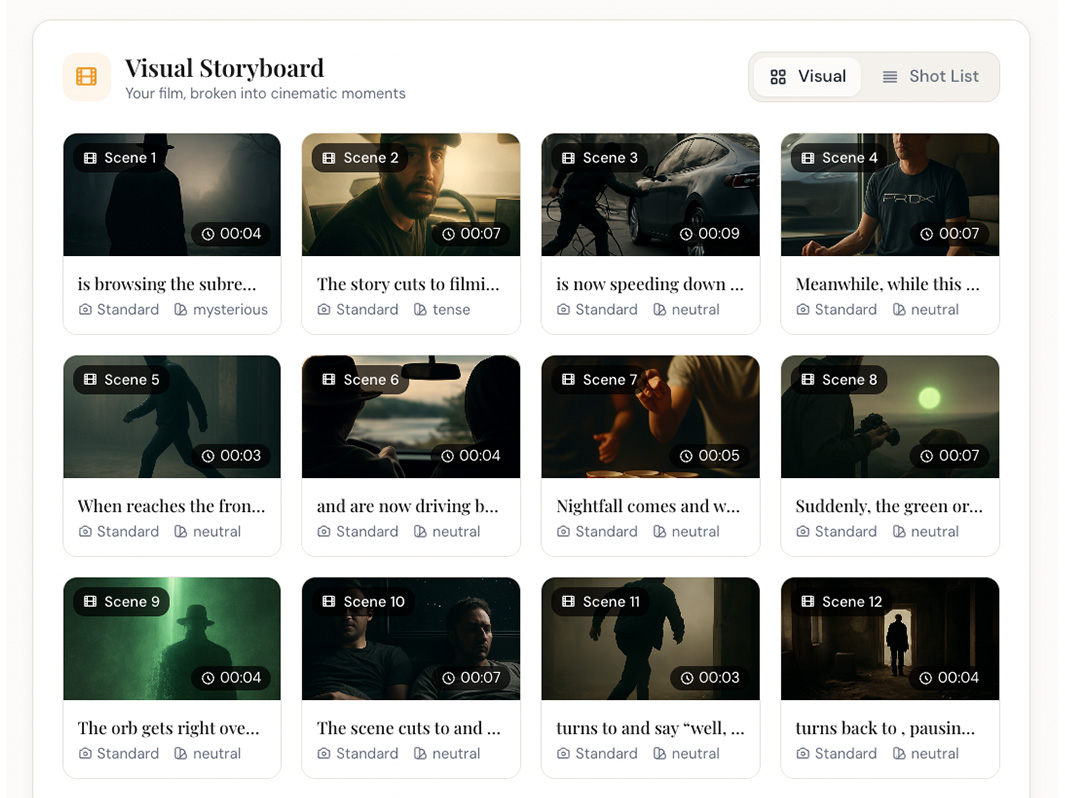


BioFrame™ — Human Translation
BioFrame translates the compiled plan into direction a creator can trust. It explains framing carry, composition, readiness, and continuity in the language of Director Review—not internal specifications.
What you're seeing: Approved composition and continuity carried from storyboard into generation review.

Physics & Camera Grammar
Per-shot physics consequences (trajectory deviation, dust displacement, debris arcs) and story-wide camera grammar distribution (static, push-in, track, handheld). Focal length and stability per shot. Same input, same output.
What you're seeing: Production-grade output with physical realism and camera variety enforced across the entire story.

The Creative Library Is Live
Explore is the public home for opt-in StoryDirector films. Watch finished work, open the story behind it, and see what governed cinematic compilation produces beyond a product demo.
Approved identities also live beyond a single project in the creator's cast library, ready to return when the next story calls for them.
Browse ExploreReady to direct your own story?